Introduction
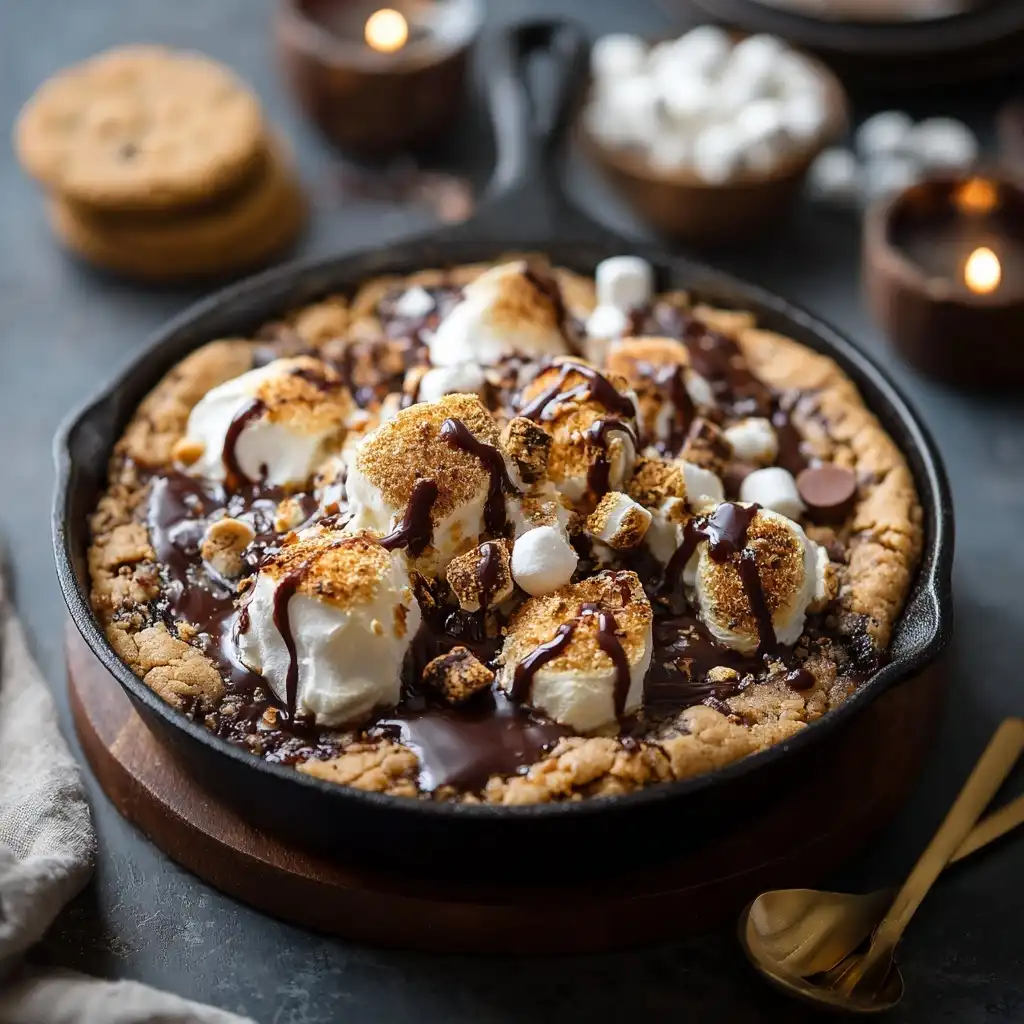
Imagine the nostalgic crackle of a campfire, the gooey stretch of toasted marshmallow clinging to your fingers, the rich snap of dark chocolate, and the buttery crunch of graham cracker—all transformed into a warm, decadent, shareable dessert that’s as comforting as it is crave-worthy. The S’mores Cookie Skillet is more than just a dessert—it’s an elevated, oven-baked homage to America’s most beloved campfire treat, reimagined as a soft-baked, thick, chewy, and luxuriously melty cookie baked directly in a cast-iron skillet. This isn’t your average drop cookie; it’s a rich, dense, slightly underbaked masterpiece with a caramelized crust, a molten center studded with pockets of melted chocolate and torched marshmallow, and a delicate graham cracker crumb halo around the edges. Whether served straight from the oven with scoops of vanilla bean ice cream, drizzled with salted caramel or chocolate ganache, or enjoyed with a spoon while still bubbling at the center, the S’mores Cookie Skillet delivers pure, unadulterated joy in every bite—and it’s surprisingly simple to make at home, no campfire required.
The History
The origins of the S’mores Cookie Skillet lie at the delicious intersection of two iconic American traditions: the s’more and the skillet cookie. The s’more itself traces back to the early 20th century—first appearing in print in the 1927 Girl Scouts handbook *Tramping and Trailing with the Girl Scouts*, where it was called “Some More!” (a playful plea for another helping). Its simplicity—graham cracker, chocolate bar, and roasted marshmallow—made it an instant favorite among scouts, families, and outdoor enthusiasts alike. Meanwhile, skillet cookies emerged as a viral baking trend in the mid-2010s, popularized by food bloggers and Instagram chefs who embraced the rustic charm and dramatic presentation of oversized, single-serving, cast-iron-baked cookies. The fusion began organically: bakers sought ways to intensify the s’more experience beyond the traditional sandwich, experimenting with layering, baking, and broiling techniques. Early iterations included s’more-stuffed chocolate chip cookies and broiled graham cracker bars—but the true breakthrough came when home cooks realized that a thick, high-fat, low-liquid cookie dough could hold its shape in a skillet while creating the perfect canvas for layered chocolate, crushed graham, and marshmallow. By 2018–2019, the S’mores Cookie Skillet had cemented itself as a staple on food blogs, TikTok dessert reels, and bakery menus nationwide—often featured during summer cookouts, holiday gatherings, and even Valentine’s Day (thanks to its romantic, share-from-one-dish appeal). Today, it stands as a testament to culinary nostalgia, modern convenience, and the irresistible allure of texture contrast: crisp, chewy, creamy, airy, and crunchy—all in one pan.
Ingredients Breakdown
Every exceptional S’mores Cookie Skillet begins with intentional, high-quality ingredients—each playing a distinct structural, textural, or flavor role. Below is a detailed, chef-level breakdown of why each component matters:
- Unsalted Butter (1 cup / 2 sticks, room temperature): Provides richness, tenderness, and flakiness. Room temperature ensures proper creaming with sugar, trapping air for lift without overdeveloping gluten. European-style butter (82–84% fat) adds extra depth and browning potential.
- Brown Sugar (1 cup packed, dark preferred): Delivers moisture, chew, and deep molasses notes. Dark brown sugar contains more molasses than light, enhancing caramelization and contributing to the cookie’s signature soft-center texture.
- Granulated Sugar (½ cup): Adds structure, crispness at the edges, and aids in spreading control. Its lower moisture content balances the hygroscopic nature of brown sugar.
- Large Eggs (2, room temperature): Act as emulsifiers and binders while contributing to lift and chew. Room temperature eggs incorporate more evenly into the batter, preventing separation and ensuring uniform texture.
- Vanilla Extract (2 tsp, pure Madagascar bourbon): Enhances sweetness perception and rounds out the chocolate-graham profile. Alcohol-free vanilla paste can be substituted for visible specks and intensified aroma.
- All-Purpose Flour (2¼ cups, spooned & leveled): The structural backbone. Too much leads to toughness; too little causes spreading. Spoon-and-level method prevents compaction and over-measuring.
- Instant Espresso Powder (1 tsp, optional but highly recommended): A secret weapon—it doesn’t make the cookie taste like coffee, but rather amplifies the chocolate’s bitterness and complexity, adding dimension without heat or acidity.
- Baking Soda (½ tsp): Reacts with the acids in brown sugar and espresso to provide subtle lift and promote browning. Not to be substituted with baking powder unless adjusting the entire leavening system.
- Fine Sea Salt (1 tsp + pinch for garnish): Balances sweetness, enhances all other flavors, and controls yeast activity (though not used here, salt remains critical for flavor modulation). Flaky Maldon or fleur de sel added post-bake provides a delightful textural pop.
- High-Quality Semi-Sweet Chocolate (12 oz, chopped or chips): Use 55–60% cacao chocolate for optimal melt and balance. Chopping bars yields irregular pockets of gooey chocolate—superior to uniform chips. Avoid “baking chips” with stabilizers that resist melting.
- Graham Crackers (1½ cups finely crushed, ~10 full sheets): Must be finely ground—not coarse crumbs—to integrate seamlessly into the dough while still delivering unmistakable honey-cinnamon notes. Pulse in a food processor until resembling coarse sand. Reserve ¼ cup for topping.
- Marshmallows (2 cups mini or 1½ cups jumbo, halved): Mini marshmallows distribute evenly and melt uniformly; jumbo ones offer dramatic visual impact and pillowy pockets. For best results, use non-GMO, corn syrup–free marshmallows—they toast more evenly and have cleaner flavor. Avoid marshmallow fluff—it lacks structure and burns easily.
- Optional Gourmet Enhancements: A handful of toasted pecans or walnuts (½ cup, chopped), a drizzle of homemade salted caramel sauce before baking, a sprinkle of cinnamon or smoked sea salt, or a dusting of freeze-dried raspberry powder for brightness.
Step-by-Step Recipe
- Preheat & Prep: Position oven rack to center position. Preheat oven to 350°F (175°C). Generously butter a 10-inch cast-iron skillet (or 9-inch if using deeper skillet); set aside. Line a small tray with parchment for marshmallow prep.
- Cream Butter & Sugars: In a large bowl using a stand mixer fitted with paddle attachment (or hand mixer), beat room-temperature butter, brown sugar, and granulated sugar on medium-high speed for 3–4 minutes until pale, fluffy, and well-combined. Scrape down bowl halfway through. Proper creaming is essential for texture—don’t rush this step.
- Incorporate Wet Ingredients: Add eggs one at a time, beating on medium speed for 30 seconds after each addition until fully incorporated and glossy. Mix in vanilla extract until combined. Batter should be smooth and slightly ribbon-like.
- Dry Ingredients Integration: In a separate bowl, whisk together flour, espresso powder (if using), baking soda, and 1 tsp fine sea salt. On low speed, gradually add dry mixture to wet mixture in three additions, mixing only until no flour streaks remain—do not overmix. Overmixing develops gluten and leads to toughness.
- Fold in Chocolate & Graham: Using a silicone spatula, gently fold in chopped chocolate and 1¼ cups graham cracker crumbs until evenly distributed. Batter will be thick, glossy, and slightly sticky—this is ideal.
- Transfer to Skillet: Scoop batter into prepared skillet. Use lightly dampened hands or an offset spatula to press evenly into the pan, smoothing the top and pushing batter slightly up the sides for even baking and a defined rim. Sprinkle reserved ¼ cup graham crumbs over surface and gently press in.
- Bake the Base: Bake for 22–26 minutes, rotating skillet halfway through, until edges are deeply golden, puffed, and set, while the center remains soft, shiny, and slightly jiggly (like a firm gelatin). An internal temperature of 195–200°F at the center indicates perfect doneness—use an instant-read thermometer for precision.
- Add Marshmallows: Remove skillet from oven. Immediately and evenly scatter marshmallows across the hot surface, pressing gently to adhere. Return to oven and broil on high for 60–90 seconds—watch closely! Marshmallows should puff, turn golden-tan, and develop light caramelized spots. Do not walk away—broiling happens fast.
- Cool & Set: Carefully remove skillet from oven (handle will be extremely hot—use thick oven mitts). Let rest on a wire rack for exactly 15 minutes—this allows residual heat to finish cooking the center while setting structure. Resist cutting or serving early—the cookie needs this time to transform from fragile to sliceable-yet-gooey.
- Final Touches & Serve: Just before serving, sprinkle with flaky sea salt and optional toasted nuts. Serve warm in the skillet with scoops of premium vanilla ice cream, a drizzle of warm chocolate ganache or salted caramel, and extra graham crackers on the side for dipping. For best texture, serve within 2 hours of baking.
Tips
- Skillet Matters: Always use a well-seasoned, oven-safe cast-iron skillet. Avoid nonstick or ceramic-coated skillets unless explicitly rated for broiling—they can warp, smoke, or release fumes. A 10-inch skillet yields ideal thickness; a 12-inch will spread too thin and bake faster.
- Butter Temperature Is Non-Negotiable: Butter should be cool to the touch but yield slightly under gentle finger pressure—about 65–68°F. Too soft = greasy, flat cookies; too cold = poor creaming and uneven texture.
- Chill the Dough? No—But Chill the Skillet? Yes!: Unlike traditional cookies, chilling this dough is discouraged—it hinders spread control and delays oven spring. However, chilling the empty skillet for 10 minutes before adding batter helps prevent premature edge-setting and encourages even rise.
- Broiling Wisdom: Broilers vary wildly. Start checking at 45 seconds. If marshmallows aren’t puffing, your broiler may be weak—move rack closer. If they’re blackening instantly, lower rack or reduce time drastically. Keep the oven light on and door slightly ajar for visibility.
- No Thermometer? Use the Wiggle Test: Gently shake the skillet—the outer 2 inches should be firm and stable; the center 3–4 inches should jiggle like Jell-O—not slosh like water. That’s your cue to pull it out.
- Rest Time Is Sacred: Cutting too soon releases steam and melts structure. The 15-minute rest allows starches to set and fats to resolidify just enough to hold shape—while preserving that magical molten core.
- Reheating Leftovers: To revive day-old skillet cookie, place uncovered in a 325°F oven for 8–10 minutes, then broil 30 seconds for marshmallow revival. Or microwave individual slices (covered) for 12–15 seconds—then top with fresh mini marshmallows and torch.
- Make-Ahead Hack: Prepare dough up to 48 hours ahead—press into skillet, cover tightly with plastic wrap, and refrigerate. Bring to room temp 30 minutes before baking—or bake straight from fridge, adding 3–5 minutes to bake time.
Variations and Customizations
The S’mores Cookie Skillet is a brilliantly adaptable canvas—ideal for seasonal twists, dietary accommodations, and gourmet upgrades. Here are 12 thoughtfully tested variations:
- Double Chocolate S’mores: Replace ¼ cup flour with unsweetened cocoa powder and add ½ cup dark chocolate chunks for intense chocolate-on-chocolate depth.
- Maple-Bourbon S’mores: Substitute ¼ cup brown sugar with pure maple syrup and add 1 tbsp barrel-aged bourbon to wet ingredients. Toast marshmallows with a bourbon-maple glaze.
- Vegan Skillet S’mores: Use vegan butter (Miyoko’s or Earth Balance), flax eggs (2 tbsp ground flax + 5 tbsp water), coconut milk yogurt (2 tbsp) for moisture, dairy-free chocolate, and vegan marshmallows (Dandies or Trader Joe’s). Skip espresso or use instant chicory root.
- Gluten-Free Skillet S’mores: Swap AP flour for 1:1 GF blend (King Arthur or Bob’s Red Mill), use GF graham crackers (Kinnikinnick or Nabisco GF), and verify chocolate is GF-certified. Add ½ tsp xanthan gum if blend doesn’t include it.
- Peanut Butter Swirl S’mores: Warm ½ cup natural peanut butter until runny; dollop over batter before marshmallows and swirl gently with a knife. Top with chopped roasted peanuts.
- Spiced Cinnamon Roll S’mores: Add 1 tsp ground cinnamon + ¼ tsp nutmeg to dry ingredients; swirl in ⅓ cup brown sugar-cinnamon filling before baking; finish with cream cheese drizzle.
- Smoky Chipotle S’mores: Add ¼ tsp chipotle powder + 1 pinch smoked paprika to dry mix. Pair with dark chocolate infused with ancho chile for a sweet-heat finish.
- White Chocolate Raspberry S’mores: Swap semi-sweet chocolate for white chocolate; fold in ¾ cup freeze-dried raspberries; top with raspberry coulis after broiling.
- Espresso Caramel Crunch S’mores: Drizzle ¼ cup salted caramel into batter pre-bake; add 2 tsp instant espresso to caramel; top with caramel-filled chocolate and sea salt.
- Kids’ Funfetti S’mores: Fold in ⅓ cup rainbow sprinkles (jimmies, not nonpareils) and use pastel marshmallows. Garnish with candy eyes and graham cracker “sticks.”
- Decadent Salted Pretzel S’mores: Fold in ¾ cup crushed kettle-cooked pretzels; use dark chocolate and flaky sea salt; finish with pretzel rod “dippers.”
- Mini Skillet Individual Servings: Divide dough among four 4-inch oiled skillets. Reduce bake time to 14–16 minutes, broil 45 seconds. Perfect for dinner parties or portion control.
Health Considerations and Nutritional Value
While undeniably indulgent, the S’mores Cookie Skillet can be approached mindfully—with transparency about its nutritional profile and thoughtful modifications for specific dietary goals:
- Caloric Profile (per 1/8 serving, 10-inch skillet): Approximately 385–420 kcal. Majority from complex carbohydrates (graham, flour), saturated fat (butter, chocolate), and simple sugars (brown/granulated sugar, marshmallows). Protein content is modest (~4g), primarily from eggs and dairy.
- Sugar Content: ~32–36g total sugar per serving—including ~22g added sugar. To reduce: cut granulated sugar by ¼ cup, use low-sugar marshmallows (Sweet D’Lites), or substitute 2 tbsp date paste for part of brown sugar (adjust flour if batter becomes too wet).
- Fat Composition: Contains ~20g total fat per serving, with ~12g saturated fat. Healthier swaps include replacing half the butter with avocado oil (for moisture + monounsaturated fats) or using grass-fed butter (higher in CLA and omega-3s). Coconut oil is not recommended—it lacks emulsifying properties and alters texture.
- Gluten & Allergen Notes: Naturally contains gluten, dairy, eggs, and soy (in most chocolate). Tree nuts are optional but common. Always check labels for shared facility warnings if managing severe allergies.
- Lower-Carb Options?: Not truly feasible without compromising identity—graham crackers and marshmallows are carb-dense by nature. Keto versions exist using almond flour, erythritol, and sugar-free marshmallows—but texture suffers significantly and marshmallow behavior changes entirely under broiler.
- Functional Additions: Boost fiber by adding 2 tbsp ground flax or psyllium husk (reduce flour by 1 tbsp). Stir in 1 tsp maca powder for adaptogenic balance or matcha for antioxidants (reduce espresso if using both).
- Mindful Enjoyment Tips: Serve smaller portions (1/10 instead of 1/8), pair with protein-rich Greek yogurt instead of ice cream, emphasize the ritual—eat slowly, savor textures, share with loved ones. Remember: desserts contribute to emotional well-being, social connection, and cultural tradition—nutrition is more than macros.
Ingredients
- 1 cup (2 sticks / 227g) unsalted butter, room temperature
- 1 cup (200g) packed dark brown sugar
- ½ cup (100g) granulated sugar
- 2 large eggs, room temperature
- 2 teaspoons pure vanilla extract
- 2¼ cups (281g) all-purpose flour, spooned & leveled
- 1 teaspoon instant espresso powder (optional but recommended)
- ½ teaspoon baking soda
- 1 teaspoon fine sea salt, plus extra for finishing
- 12 ounces (340g) high-quality semi-sweet chocolate (55–60% cacao), finely chopped
- 1½ cups (about 10 full sheets) graham crackers, finely crushed (reserve ¼ cup for topping)
- 2 cups (about 100g) mini marshmallows—or 1½ cups jumbo marshmallows, halved
- Flaky sea salt (e.g., Maldon), for garnish
Directions
- Preheat oven to 350°F (175°C). Butter a 10-inch oven-safe cast-iron skillet generously and set aside.
- In the bowl of a stand mixer fitted with paddle attachment, beat butter, brown sugar, and granulated sugar on medium-high speed for 3–4 minutes until light, fluffy, and pale in color. Scrape down bowl as needed.
- Add eggs one at a time, beating for 30 seconds after each addition until fully incorporated and glossy. Mix in vanilla extract.
- In a separate bowl, whisk together flour, espresso powder (if using), baking soda, and 1 tsp fine sea salt.
- On low speed, gradually add dry ingredients to wet ingredients in three parts, mixing only until no dry streaks remain. Do not overmix.
- Using a silicone spatula, fold in chopped chocolate and 1¼ cups graham cracker crumbs until evenly dispersed.
- Transfer dough to prepared skillet. Press evenly into pan with damp hands or offset spatula, smoothing top and encouraging slight rise up sides. Sprinkle reserved ¼ cup graham crumbs over surface and gently press in.
- Bake for 22–26 minutes, rotating halfway, until edges are deeply golden and set, and center is soft, shiny, and slightly jiggly. Internal temperature should read 195–200°F.
- Remove from oven. Immediately scatter marshmallows evenly over hot surface. Return to oven and broil on high for 60–90 seconds, watching closely, until marshmallows are puffed and golden-tan.
- Let rest on wire rack for exactly 15 minutes. Sprinkle with flaky sea salt. Serve warm directly from skillet with ice cream, sauces, or graham crackers.
FAQ
- Can I make this ahead of time?
- Yes! Assemble unbaked dough in skillet, cover tightly with plastic wrap, and refrigerate up to 48 hours. Let sit at room temperature 30 minutes before baking—or bake cold, adding 3–5 minutes to bake time.
- Why did my cookie spread too much or become cakey?
- Over-creaming butter/sugar, using melted or overly soft butter, measuring flour incorrectly (scooping vs. spooning), or omitting the espresso/baking soda can cause structural issues. Also ensure your baking soda is fresh—test by mixing ¼ tsp with 2 tsp vinegar; it should bubble vigorously.
- Can I use store-bought graham cracker crumbs?
- You can—but most contain added oils, preservatives, and sugar that mute flavor and alter texture. Homemade crumbs deliver superior honeyed warmth and better integration. If using store-bought, choose plain (not cinnamon) and reduce added salt by ¼ tsp.
- My marshmallows burned instantly under the broiler—what went wrong?
- Your broiler is likely too intense or the rack is too close. Move oven rack down one position, use shorter bursts (30 sec on, 15 sec off), or switch to kitchen torch for precise, even toasting. Never leave unattended.
- Can I freeze the baked skillet cookie?
- Yes—but texture changes. Cool completely, wrap skillet tightly in double layers of plastic + foil, and freeze up to 1 month. Thaw overnight in fridge, then reheat covered at 325°F for 15 minutes before broiling fresh marshmallows.
- Is there a way to make it less sweet?
- Absolutely. Reduce granulated sugar to ⅓ cup, use 70% dark chocolate, skip the graham topping, and finish with flaky salt only—no extra sugar garnish. The espresso powder also cuts perceived sweetness.
- What if I don’t have a cast-iron skillet?
- Use a heavy-duty 10-inch ovenproof stainless steel or enameled cast iron pan. Avoid glass (Pyrex) unless verified safe for broiling—it may shatter. Aluminum or nonstick pans often warp or discolor at high heat.
- Can I add nuts or other mix-ins?
- Yes—fold in up to 1 cup toasted nuts (pecans, walnuts, almonds) or dried fruit (chopped apricots, cranberries) with chocolate. Avoid raw nuts—they won’t toast sufficiently in the short bake time.
- How do I clean the skillet afterward?
- Let cool completely. Soak in warm soapy water for 10 minutes. Use a nylon brush or chainmail scrubber (not steel wool) to loosen residue. Dry immediately and re-season with oil if needed. Never soak overnight or use harsh detergents.
- Can kids help make this?
- Yes—with supervision! They can measure dry ingredients, crush graham crackers (in a zip-top bag with rolling pin), stir in chocolate, press dough into skillet, and place marshmallows. Broiling and oven handling must be adult-only.
Summary
The S’mores Cookie Skillet is a masterclass in nostalgic reinvention—melding campfire magic with artisanal baking technique to create a rich, chewy, molten-centered dessert that’s equal parts comfort and celebration.
Baked in a sizzling cast-iron skillet and crowned with golden-toasted marshmallows, it’s best served warm, shared generously, and savored slowly—with ice cream, laughter, and the joyful messiness that only the very best desserts inspire.