Introduction
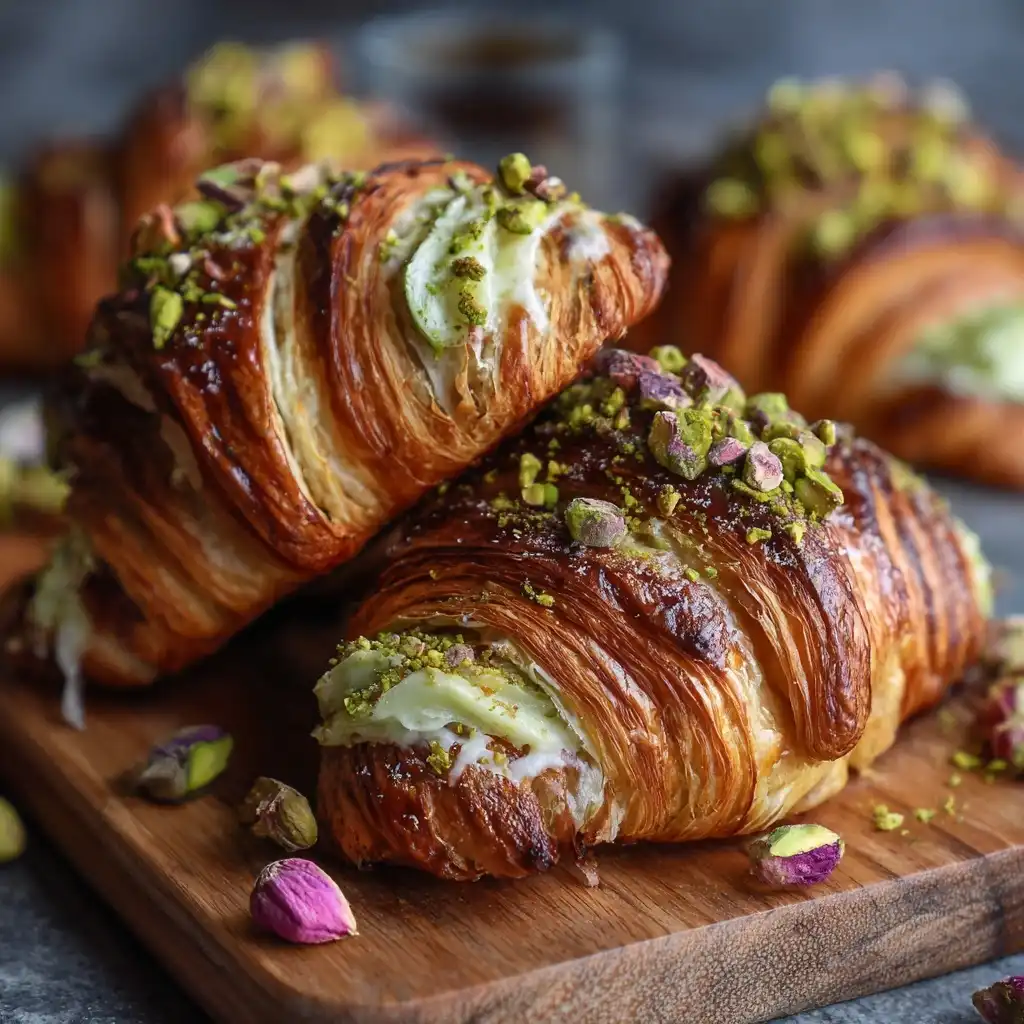
Pistachio Cream Croissants are a luxurious, modern twist on the classic French viennoiserie—elevating the buttery, flaky croissant with a rich, vibrant, and subtly sweet pistachio filling that delights both the palate and the eye. These pastries bridge tradition and innovation: rooted in centuries-old laminated dough techniques yet infused with the nutty sophistication of Middle Eastern and Mediterranean flavors. With their delicate green hue, aromatic depth, and creamy texture, Pistachio Cream Croissants have surged in popularity across artisanal bakeries, high-end patisseries, and home baking circles alike—appealing to those seeking elegance, nuance, and a touch of indulgence in every bite.
The History
The croissant’s lineage traces back to 13th-century Austria (as the Kipfel) and was later refined in 19th-century Paris, where Austrian baker August Zang introduced Viennese baking methods—including laminated dough—to France. The modern croissant as we know it solidified by the 1920s, codified by French bakers who perfected its airy crumb and shattering crust. Pistachios, meanwhile, boast an even older legacy—cultivated for over 8,000 years across Central Asia, Persia, and the Levant. Revered in Persian confections like sohan and Turkish baklava, pistachios were historically prized for their rarity, color, and symbolic associations with prosperity and renewal.
It wasn’t until the late 20th and early 21st centuries—fueled by globalization, rising interest in Middle Eastern ingredients, and the “green dessert” movement—that pistachio began appearing in European pastry applications beyond ice cream or brittle. Chefs like Pierre Hermé (who pioneered the iconic Paris-Brest Pistachio in the 1990s) and later, contemporary bakers from Beirut to Brooklyn, began marrying pistachio paste with laminated doughs. The Pistachio Cream Croissant emerged organically from this cross-cultural dialogue: a celebration of terroir (French technique + Iranian/Turkish pistachios), craftsmanship, and sensory harmony—where the nut’s earthy-sweetness balances the croissant’s rich, yeasty tang and caramelized butter notes.
Ingredients Breakdown
Every exceptional Pistachio Cream Croissant relies on two masterfully executed components: the laminated croissant dough and the pistachio cream filling. Below is a detailed, purpose-driven breakdown of each ingredient—not just *what* goes in, but *why* it matters:
- Unbleached All-Purpose Flour (or Bread Flour Blend): Provides optimal gluten development for structure and elasticity during lamination. A small percentage of bread flour (10–15%) adds chew and resilience without compromising tenderness.
- Granulated Sugar: Feeds yeast for fermentation, contributes to browning via Maillard reaction, and subtly enhances flavor complexity—not sweetness alone.
- Active Dry Yeast or Instant Yeast: The engine of lift and aroma. Cold-fermented overnight (retardation) develops nuanced, slightly fruity esters while improving dough handling.
- Whole Milk (warmed to 105°F/40°C): Adds lactose for browning, proteins for structure, and fat for tenderness. Full-fat milk yields superior flavor and richness versus skim or plant alternatives.
- Unsalted Butter (European-style, 82–84% fat): Non-negotiable for flakiness. High-fat butter melts more slowly during baking, creating distinct, airy layers. Must be cool (60–65°F/15–18°C) during lamination—firm enough to hold shape but pliable enough to roll.
- Fine Sea Salt: Controls fermentation speed, strengthens gluten, and deepens overall flavor perception—balancing sweetness and nuttiness.
- Pistachio Paste (Premium, Unsalted, Roasted): The soul of the filling. Look for 100% pistachio (no added oils, sugars, or stabilizers). Iranian or Sicilian varieties offer the most complex, floral, and chlorophyll-rich profiles. Avoid “pistachio spread” with palm oil—it separates and lacks depth.
- Heavy Cream (36–40% fat): Adds silkiness, moisture, and fat content to the cream—preventing graininess and ensuring smooth pipeability. Ultra-pasteurized cream is preferred for stability.
- Confectioners’ Sugar (Sifted): Dissolves instantly into the cream, providing gentle sweetness without grit. Contains cornstarch, which also helps stabilize the emulsion.
- Vanilla Bean Paste (not extract): Offers real vanilla seeds and concentrated flavor that complements—not competes with—pistachio’s earthiness. Alcohol-based extracts can dull delicate nut aromas.
- Pinch of Ground Cardamom (optional but recommended): A traditional Persian pairing that lifts the pistachio with citrusy, floral warmth—use sparingly (¼ tsp per 1 cup filling) to avoid overpowering.
- Egg Wash (1 egg + 1 tbsp cream, whisked): For golden sheen and glossy finish. A light brush ensures even color without pooling.
- Chopped Toasted Pistachios (for garnish): Adds textural contrast and visual appeal. Toast lightly (3–4 min at 325°F/160°C) to intensify aroma and deepen color.
Step-by-Step Recipe
This comprehensive method assumes intermediate baking experience. Total timeline: ~28–36 hours (including cold fermentation), with ~4 hours of active time. Patience is non-negotiable—the magic lives in the slow development.
Phase 1: The Dough (Day 1, Evening)
- Mix the Detrempe (Base Dough): In a stand mixer fitted with a dough hook, combine 500g all-purpose flour, 100g bread flour, 60g granulated sugar, 10g fine sea salt, and 10g instant yeast. Mix on low 1 minute. Gradually add 300g lukewarm whole milk (105°F) and mix 4–5 minutes until smooth, supple, and slightly tacky (like soft clay). Dough temperature should be 75–78°F. Transfer to a lightly oiled bowl, cover with plastic, and rest at room temp 30 minutes.
- Prepare the Butter Block: While detrempe rests, cut 450g cold European butter into ½-inch cubes. Place on parchment; cover with another sheet. Pound gently with a rolling pin into a 7″ × 7″ square (~¾” thick). Chill 15 minutes—butter must be firm but not brittle.
- Lamination (3 Turns, Refrigerated): Roll detrempe into a 10″ × 10″ square on a lightly floured surface. Place chilled butter block centered on dough. Fold dough like a business letter (top third down, bottom third up) to fully encase butter. Seal edges. Rotate 90°. Roll into an 8″ × 24″ rectangle. Perform a “letter fold” (fold thirds again). Wrap tightly in plastic; refrigerate 45 minutes. Repeat twice more (total 3 turns), chilling 45 min between each. After final turn, shape into a 12″ log, wrap, and refrigerate overnight (12–16 hrs).
Phase 2: Shaping & Proofing (Day 2, Morning)
- Prep & Portion: Remove dough from fridge. Let sit 10 minutes to soften slightly. Cut into 12 equal pieces (~125g each). Roll each into a 10″ × 4″ rectangle (long side horizontal). Trim uneven edges for clean lamination.
- Filling Application: Pipe or spread 25g pistachio cream (recipe below) in a line along the center of each rectangle. Leave ½” border on long sides.
- Shaping: Starting from a short end, tightly roll each rectangle into a crescent shape, tucking the tip underneath. Gently curve ends inward to form classic crescent shape. Place seam-side down on parchment-lined sheet trays, spaced 3″ apart.
- Final Proof: Cover loosely with greased plastic or proofing cloches. Proof at 78–80°F and 75% humidity for 2.5–3.5 hours—until puffed, jiggly, and nearly doubled. A gentle finger press should leave a slow, partial rebound (not spring back fully nor collapse).
Phase 3: Pistachio Cream Filling (Made Day 2, Morning)
- In a food processor, blend 200g premium pistachio paste, 100g heavy cream, 75g sifted confectioners’ sugar, 1 tsp vanilla bean paste, and ¼ tsp ground cardamom until completely smooth (2–3 min), scraping sides often. Texture should be thick but pipeable—like softened butter. Chill 30 minutes before use. Do not over-chill (<40°F) or it will harden and tear dough during shaping.
Phase 4: Baking & Finishing (Day 2, Late Morning)
- Preheat & Prep: Position oven racks in upper and lower thirds. Preheat to 400°F (200°C) convection or 425°F (220°C) conventional 45 minutes prior. Place a baking stone or heavy sheet pan on lower rack.
- Egg Wash & Garnish: Gently brush croissants with egg wash using a soft pastry brush. Sprinkle generously with finely chopped toasted pistachios.
- Bake: Place trays on preheated stone/rack. Immediately reduce heat to 375°F (190°C). Bake 18–22 minutes—rotating trays top-to-bottom and front-to-back at 12 minutes—until deeply golden brown, crisp, and hollow-sounding when tapped. Internal temperature should reach 205–210°F (96–99°C).
- Cool: Transfer to wire racks immediately. Cool minimum 25 minutes before serving—critical for steam release and cream setting. Serve warm or at room temperature.
Tips
- Butter Temperature is Everything: Too cold = shattering; too warm = absorption into dough = no layers. Use an instant-read thermometer. Ideal working temp: 60–65°F (15–18°C).
- Flour Hydration Matters: Humidity affects absorption. Reserve 25g flour to adjust—dough should be tacky but not sticky. If overly wet after mixing, add flour 5g at a time.
- Never Skip the Retardation: Overnight chilling relaxes gluten, improves layer definition, and develops flavor. Freezing dough (up to 3 weeks) works—but thaw overnight in fridge before shaping.
- Proofing Environment is Key: Use a proofing box, oven with bowl of hot water + light on, or microwave with steaming towel. Under-proofed = dense; over-proofed = collapsed, greasy, and pale.
- Pistachio Paste Quality is Non-Negotiable: Taste it raw. It should smell green, grassy, and faintly sweet—not rancid, oily, or artificial. Brands like La Maison du Chocolat, Orgran, or So Nuts! (unsweetened) are reliable.
- Rolling Technique: Always roll away from you, applying even pressure. Lift and rotate dough ¼ turn every few rolls to maintain rectangle shape and prevent sticking.
- Avoid Over-Filling: Too much cream causes blowouts and leaks. 25g is ideal for standard 125g portions. Use a scale—not volume—for consistency.
- Steam Helps Crust Development: For extra shine and lift, toss 2 ice cubes into oven floor (below stone) right after loading—then close door quickly. Not essential, but elevates professional results.
- Storage & Reheating: Best eaten same day. Store airtight at room temp up to 12 hours. To refresh: 5 min at 350°F (175°C) on wire rack. Do not microwave—melts layers and makes them rubbery.
Variations and Customizations
The Pistachio Cream Croissant serves as a stunning canvas for creative expression—respecting its core identity while inviting thoughtful adaptation. Here are rigorously tested, bakery-proven variations:
Gourmet Flavor Infusions
- Rosewater-Pistachio: Add ½ tsp food-grade rosewater + 1 tsp dried rose petals (crushed) to cream. Pairs exquisitely with cardamom and orange blossom honey glaze.
- Dark Chocolate Pistachio: Fold 60g finely chopped 70% dark chocolate into warm cream just before chilling. Creates melty pockets and bittersweet contrast.
- Saffron-Pistachio: Steep 12 delicate saffron threads in 1 tbsp warm cream for 15 min; strain and stir into cooled cream. Imparts luminous gold hue and honeyed, hay-like perfume.
Dietary & Lifestyle Adaptations
- Vegan Pistachio Croissants: Substitute dairy-free cultured butter (Miyoko’s or Naturli’), oat milk (barista edition), and flax “egg” wash (1 tbsp ground flax + 3 tbsp water). Use coconut cream (refrigerated, solid part only) blended with pistachio paste for filling. Requires precise hydration adjustment (+5–10g liquid).
- Gluten-Free Option: Use certified GF 1:1 blend (King Arthur or Caputo Fioreglut) + xanthan gum (1 tsp per 500g flour). Expect denser crumb—compensate with extra yeast (12g) and longer bulk ferment (2 hrs at room temp before chilling).
- Low-Sugar Version: Replace confectioners’ sugar in filling with erythritol-based blend (Swerve Confectioners) + ¼ tsp stevia glycerite. Reduce dough sugar to 30g. Note: Yeast activity slows—extend bulk ferment by 30–45 min.
Form & Presentation Twists
- Pistachio-Almond Croissant (Pain au Pistachio-Amande): Top baked croissants with sliced almonds and a drizzle of almond glaze (powdered sugar + almond milk + amaretto). Toast 3 min at 350°F.
- Pistachio-Custard Swirl: Pipe pistachio cream *and* vanilla pastry cream in alternating lines before rolling—creates marbled interior and dual-texture bite.
- Mini Pistachio “Crescents”: Portion dough into 60g pieces. Roll to 7″ × 3″, fill with 12g cream, and shape into 3″ mini-croissants. Bake 14–16 min. Perfect for brunch service or gift boxes.
- Savory-Pistachio “Kouign Amann Style”: Add 1 tsp flaky sea salt + 2 tbsp grated aged Gruyère to pistachio cream. Brush exterior with garlic-infused olive oil before baking. Unexpected umami depth.
Health Considerations and Nutritional Value
While undeniably indulgent, Pistachio Cream Croissants offer meaningful nutritional attributes when approached mindfully. Below is a detailed analysis per standard 125g croissant (based on recipe above):
Nutritional Profile (Approximate)
- Calories: 420–460 kcal
- Total Fat: 28–31g (16–18g saturated, primarily from butter and pistachios)
- Carbohydrates: 40–43g (12–14g sugars, including naturally occurring lactose and sucrose)
- Protein: 7–9g (from flour, milk, eggs, and pistachios)
- Fiber: 2.5–3g (pistachios contribute ~1g per 25g; whole-grain flour substitution boosts significantly)
- Vitamins & Minerals: Rich in Vitamin B1 (thiamine), B6, copper, manganese, phosphorus, and magnesium. Pistachios provide heart-healthy monounsaturated fats and plant sterols shown to support cholesterol balance.
Health-Conscious Notes
- Butter vs. Alternatives: European butter contains butyrate—a short-chain fatty acid linked to gut health and anti-inflammatory effects. While high in sat fat, recent meta-analyses (e.g., BMJ Open Heart, 2023) suggest moderate dairy fat intake does not increase CVD risk in healthy adults.
- Pistachios: A Functional Superfood: Among nuts, pistachios rank highest in antioxidants (lutein, gamma-tocopherol) and potassium. Their fiber-protein-fat matrix promotes satiety and steady glucose response—making them a smarter choice than refined sugar fillings.
- Yeast Fermentation Benefits: Overnight cold fermentation breaks down phytic acid (improving mineral absorption) and produces beneficial organic acids (lactic, acetic), enhancing digestibility and lowering glycemic load versus same-day dough.
- Mindful Enjoyment Guidelines: Treat as a mindful ritual—not daily fare. Pair with antioxidant-rich black tea or tart cherry juice. Savor slowly: 15+ minutes per croissant aids digestion and satisfaction signaling. Those with nut allergies, celiac disease, or severe lactose intolerance must avoid unless certified-safe substitutions are used.
Ingredients
Makes 12 standard croissants
For the Laminated Dough
- 500g unbleached all-purpose flour
- 100g bread flour
- 60g granulated sugar
- 10g fine sea salt
- 10g instant yeast
- 300g whole milk (105°F / 40°C)
- 450g European-style unsalted butter (82–84% fat), cold
For the Pistachio Cream Filling
- 200g premium unsalted roasted pistachio paste
- 100g heavy cream (36–40% fat)
- 75g confectioners’ sugar, sifted
- 1 tsp vanilla bean paste
- ¼ tsp ground cardamom (optional but recommended)
For Finishing
- 1 large egg + 1 tbsp heavy cream (egg wash)
- 30g unsalted roasted pistachios, finely chopped
Directions
Refer to the Step-by-Step Recipe section above for complete, chronologically ordered instructions—including timing windows, temperature targets, troubleshooting cues, and pro techniques. This condensed version serves as a quick-reference checklist only:
- Mix detrempe; rest 30 min.
- Prepare & chill butter block.
- Complete 3 lamination turns (letter folds), chilling 45 min between each.
- Chill laminated dough overnight (12–16 hrs).
- Portion, roll, fill (25g cream), and shape into crescents.
- Proof 2.5–3.5 hrs at 78–80°F until puffed and jiggly.
- Brush with egg wash; garnish with chopped pistachios.
- Bake at 400°F (200°C) for 2 min, then reduce to 375°F (190°C); bake 18–22 min total, rotating halfway.
- Cool 25+ minutes on wire racks before serving.
FAQ
- Q: Can I use store-bought croissant dough?
- A: Technically yes—but quality varies wildly. Most commercial doughs contain shortening, preservatives, and low-butter content (<30%), resulting in less flakiness and muted flavor. For authentic texture and richness, homemade laminated dough is strongly recommended. If using store-bought, choose “all-butter” brands like Trader Joe’s or Pepperidge Farm—and expect a softer, less defined crumb.
- Q: Why did my pistachio cream separate or leak during baking?
- A: Three likely causes: (1) Cream was too cold (<40°F) when piping—causing dough tears; (2) Overfilling (>25g) or uneven distribution created weak points; (3) Butter in dough was too warm during lamination, causing fat migration. Solution: Warm cream to 65°F before piping, weigh fillings, and verify butter temp during lamination.
- Q: My croissants didn’t rise much during proofing. What went wrong?
- A: Most common culprits: expired or inactive yeast (always proof yeast in warm milk + pinch sugar first); dough too cold (never skip the 10-min bench rest before shaping); or insufficient proofing time/temp. Also check your oven’s proof setting—if using, calibrate with an oven thermometer.
- Q: Can I prepare the dough ahead and freeze it?
- A: Absolutely. After final lamination and shaping (but before proofing), place unbaked croissants on a tray, freeze solid (2 hrs), then transfer to airtight freezer bags. Freeze up to 3 weeks. To bake: thaw overnight in fridge, then proof 2–2.5 hrs at 78°F. No need to bring to room temp first.
- Q: Is there a way to make them less rich?
- A: Yes—strategically. Reduce butter to 400g (still laminated) and replace 50g with clarified butter (ghee) for flavor without excess moisture. Use 2% milk instead of whole (adjust flour by +5g). In filling, swap 25g heavy cream for Greek yogurt (full-fat, strained)—adds tang and protein. Never cut butter below 350g without reformulating—structure collapses.
- Q: How do I achieve that signature deep golden-brown, glossy crust?
- A: Three keys: (1) Egg wash must be thin—add cream to prevent pooling; (2) Bake on a preheated stone or heavy pan for radiant heat; (3) Use convection mode if available (reduces time/temp variance). Optional pro trick: Brush *again* with egg wash at 10-minute mark for extra shine.
- Q: Can I add chocolate chips to the filling?
- A: Yes—but use high-quality 60–70% dark chocolate, finely chopped (not chips—they contain stabilizers that don’t melt cleanly). Fold in *after* cream is fully chilled and thickened. Warm chocolate will melt the cream emulsion. Limit to 60g per batch to avoid weight-induced spreading.
- Q: What’s the best pistachio variety for paste?
- A: Iranian Kerman pistachios offer the boldest, greenest, most aromatic profile—ideal for premium pastes. Sicilian Bronte DOP pistachios provide intense sweetness and floral notes. Avoid Turkish or American varieties unless labeled “roasted & unsalted”—they’re often over-roasted or salted, muting subtlety.
Summary
Pistachio Cream Croissants represent the pinnacle of cross-cultural pastry artistry—marrying French laminated technique with the ancient, sun-drenched essence of Persian and Mediterranean pistachios to create a delicately flaky, luxuriously creamy, and vibrantly aromatic indulgence that satisfies both tradition and innovation.
With meticulous attention to ingredient provenance, temperature discipline, fermentation timing, and respectful customization, these croissants transcend trend to become a timeless, sensorially profound experience—equally at home in a Parisian salon de thé, a Beirut rooftop café, or your own kitchen as a weekend ritual of patience, pleasure, and craft.