Introduction
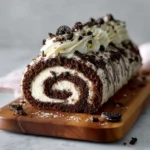
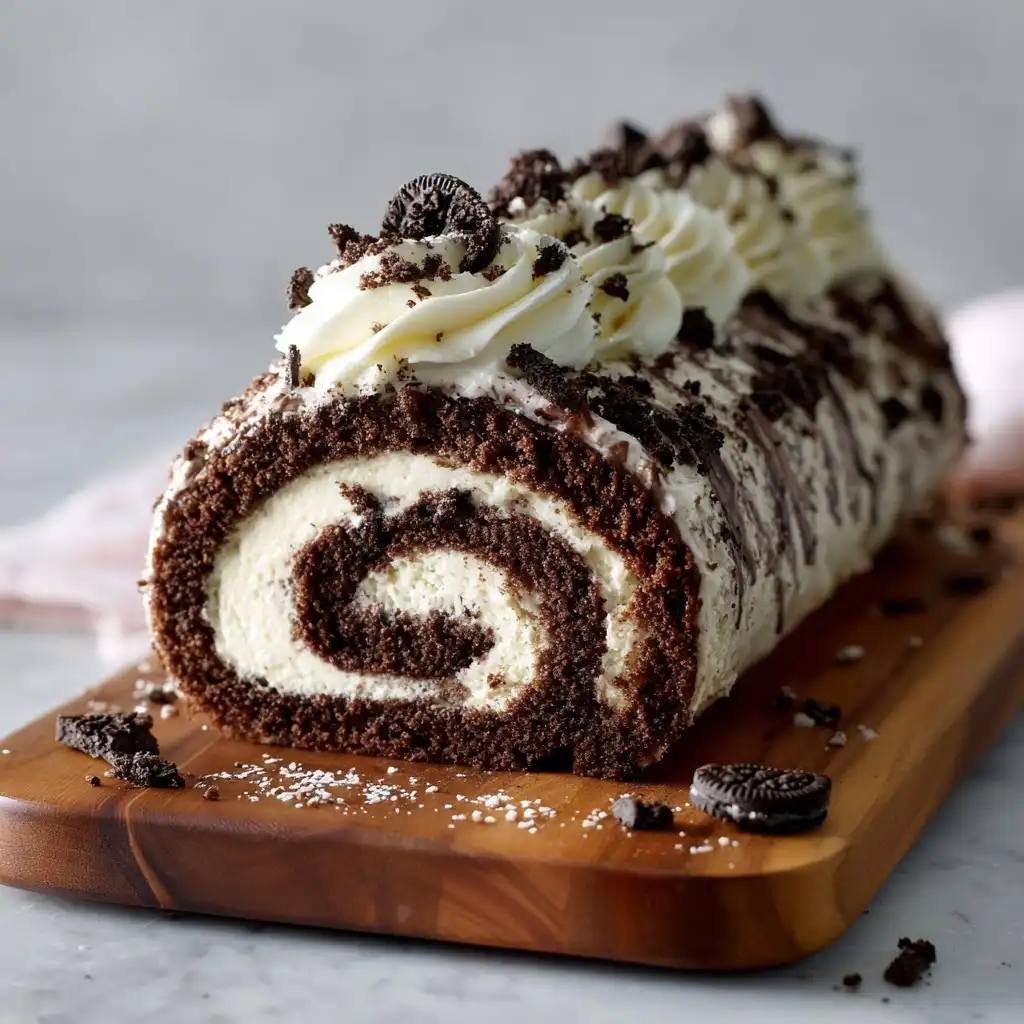
The Cookies and Cream Cake Roll—also affectionately known as a Swiss roll, jelly roll, or roulade—is a stunning, elegant dessert that marries the nostalgic charm of classic American cookies and cream with the delicate artistry of rolled sponge cake. Unlike traditional layer cakes, this dessert features a tender, airy vanilla sponge unfurled to reveal a luxuriously creamy, crumb-studded filling—typically made with high-quality vanilla buttercream or whipped ganache folded with crushed Oreos® or other chocolate sandwich cookies. Its seamless spiral presentation, glossy sheen, and striking contrast of snowy white filling against golden-brown cake make it a showstopper at birthdays, holidays, bridal showers, and summer picnics alike. More than just a treat, the Cookies and Cream Cake Roll is a celebration of texture: springy yet yielding cake, cool and cloud-like frosting, and the irresistible *crunch-snap* of embedded cookie pieces in every slice.
The History
The origins of the cake roll trace back centuries—to 17th-century Europe, where early versions appeared in Austrian and Swiss cookbooks as “Biskuitrolle” or “Roulade.” These were simple genoise-style sponges rolled while warm with jam or nut pastes. The technique migrated across continents, evolving with local ingredients and sensibilities. In the United States, the mid-20th century saw an explosion of cake roll popularity, fueled by home economics classes, women’s magazines like Betty Crocker’s Picture Cook Book (1950), and the rise of convenient packaged goods—including the iconic Oreo®, first introduced by Nabisco in 1912. Though not originally conceived together, the natural synergy between the creamy vanilla filling of Oreos® and the light sweetness of sponge cake led enterprising bakers in the 1970s and ’80s to experiment with incorporating crushed cookies into both fillings and garnishes. By the 1990s, “Cookies and Cream” had cemented itself as a beloved ice cream flavor—and soon after, a full-fledged dessert category. Today’s Cookies and Cream Cake Roll stands at the intersection of European technique, American ingenuity, and modern flavor trends—honoring tradition while delighting in playful, comforting nostalgia.
Ingredients Breakdown
Understanding each component is essential for success—especially since a cake roll relies on precise chemistry and timing. Below is a detailed functional breakdown of every ingredient, including why substitutions work (or don’t) and what they contribute structurally and sensorially:
- Eggs (whole + yolks): Provide structure, moisture, emulsification, and leavening. Room-temperature eggs whip to greater volume—critical for a lofty, flexible sponge. Separating eggs allows for stabilized meringue (whites) and enriched yolk batter (for tenderness).
- Granulated sugar: Sweetens, stabilizes egg foam, and aids in browning. Superfine (caster) sugar dissolves faster and yields smoother texture—but granulated works well when beaten thoroughly with eggs.
- All-purpose flour (spooned & leveled): Offers balanced gluten development—enough for elasticity but not toughness. Sifting 3x ensures no lumps and even distribution, preventing tunnels or tears during rolling.
- Cornstarch: Added in small amounts (typically 1–2 tbsp), it inhibits gluten formation, resulting in a more delicate, tender crumb and improved rollability—especially crucial for beginners.
- Unsweetened cocoa powder (optional, for marble or swirl variations): Dutch-processed preferred for deeper color and neutral pH, which pairs better with baking powder if used. Natural cocoa may require acid adjustment.
- Salt: Enhances all flavors and tempers sweetness without tasting salty. Fine sea salt or kosher salt dissolves evenly.
- Vanilla extract (pure, not imitation): Imparts complex floral, woody notes that elevate the entire profile. Bourbon-vanilla beans or paste may be substituted for intensified aroma.
- Vegetable oil or melted unsalted butter: Adds moisture, richness, and flexibility. Oil yields a more tender, shelf-stable roll; butter contributes superior flavor and subtle browning notes (but must be cooled to avoid cooking egg mixture).
- White vinegar or cream of tartar (in meringue): Stabilizes egg whites by lowering pH, encouraging stronger protein bonds—leading to stiffer, glossier peaks that hold air longer during folding and baking.
- Heavy whipping cream (for filling): Minimum 36% milkfat ensures proper whipping stability and luxurious mouthfeel. Ultra-pasteurized cream may take longer to whip but holds longer; pasteurized whips faster but may weep sooner.
- Powdered sugar (confectioners’ sugar): Contains cornstarch (3%) to prevent caking—this same starch helps thicken fillings and stabilize whipped cream. Sift before use to avoid grittiness.
- Full-fat cream cheese (room temperature): Provides tang, body, and emulsifying power—essential for stable, spreadable, non-sliding fillings. Low-fat or whipped varieties lack structure and often separate.
- Oreo® or premium chocolate sandwich cookies: Choose cookies with creamy, non-greasy fillings and crisp wafers. “Golden Oreos” or “Mint Oreos” offer fun variations. For dietary needs: certified gluten-free or vegan sandwich cookies (e.g., From the Ground Up, Mi-Del) perform admirably when tested in advance.
- Optional enhancements: A pinch of espresso powder (enhances chocolate notes without tasting like coffee), clear vanilla bean paste (for visible specks and depth), freeze-dried cookie powder (for intensified flavor without added moisture), or edible pearl dust (for shimmering finish).
Step-by-Step Recipe
- Prep & Preheat: Line a 10×15-inch rimmed jelly roll pan with parchment paper—extending 2 inches over the short ends for easy lifting. Lightly grease the parchment and pan sides. Preheat oven to 350°F (177°C). Set oven rack to center position. Have cooling rack ready, covered with clean cotton towel sprinkled lightly with powdered sugar (for rolling).
- Make the Sponge Batter: In a large bowl, whisk together 4 large room-temperature eggs, 1 cup granulated sugar, 2 tsp pure vanilla extract, and ¼ tsp fine sea salt until pale, thick, and tripled in volume (≈5–7 min with stand mixer on medium-high; 8–10 min with hand mixer). Mixture should fall from whisk in thick ribbons that hold shape for 3–5 seconds (“ribbon stage”).
- Fold in Dry Ingredients: Sift together ½ cup all-purpose flour, 2 tbsp cornstarch, and ¼ tsp baking powder (optional, for extra lift). In 3 gentle additions, fold dry mix into egg mixture using a flexible silicone spatula—cutting down center, sweeping across bottom, and folding up and over. Rotate bowl ¼ turn between folds. Stop as soon as no streaks remain—overmixing deflates air and causes toughness.
- Add Fat & Finish Batter: Whisk ¼ cup neutral oil (e.g., grapeseed or avocado) and 2 tbsp cooled melted unsalted butter into ¼ cup of batter to temper, then fold mixture back into main batter in 2 additions. Batter should be glossy, smooth, and pourable—but thick enough to mound slightly.
- Bake the Sponge: Pour batter into prepared pan. Tilt and tap pan firmly to level surface and release air bubbles. Bake 13–15 minutes—until top springs back when gently pressed, edges pull slightly from pan, and surface is uniformly golden with faint crackling. Do NOT overbake—dry sponge will crack when rolled.
- Cool & Prep for Rolling: Immediately upon removal from oven, run thin knife around pan edges. Invert warm cake onto powdered sugar–dusted towel. Carefully peel off parchment. Starting at one short end, tightly roll cake + towel together—like a sleeping bag. Place seam-side down on wire rack. Let cool completely (≈1 hour)—this sets the shape and prevents filling melt-through.
- Prepare the Filling: In chilled bowl, beat 16 oz (2 bricks) full-fat cream cheese (room temp) until silky. Add 1 cup powdered sugar (sifted), 1 tsp vanilla, and ⅛ tsp salt—beat 2 min until smooth. Gradually add 1¼ cups cold heavy cream in 3 additions, beating on medium until stiff peaks form (≈3–4 min total). Gently fold in 1¼ cups finely crushed Oreos® (reserve 2 tbsp for garnish). Chill filling 20 min for easier spreading.
- Unroll, Fill, and Reroll: Unroll cooled cake gently. Trim ¼-inch off both long edges for clean appearance. Evenly spread filling to within ½ inch of edges using offset spatula. Leave short ends bare for tight seal. Lift edge closest to you, and roll cake away—using parchment or plastic wrap to guide. Apply gentle, even pressure. Seal seam by pressing lightly. Wrap tightly in plastic—refrigerate minimum 3 hours (overnight ideal) to set.
- Finish & Serve: Unwrap. Dust generously with powdered sugar using fine-mesh sieve. Decorate with reserved cookie crumbs, mini Oreos®, white chocolate curls, or edible glitter. Slice with serrated knife dipped in hot water and wiped dry between cuts. Serve chilled.
Tips
- Temperature is non-negotiable: Eggs, butter, cream cheese, and cream must be at specified temperatures—or your batter won’t aerate, your filling won’t whip, and your roll will resist shaping.
- Parchment > Grease-only: A greased pan alone causes sticking and tearing. Parchment provides grip and release—even when cake is delicate.
- Roll while warm—but not hot: Rolling within 2 minutes of baking locks in pliability. Wait too long, and the cake firms; too soon, and steam makes it soggy.
- The towel trick is transformative: A lint-free, absorbent cotton towel (not terry cloth) absorbs surface moisture and gives traction—preventing slippage and tears.
- Crush cookies intentionally: Pulse in food processor until varied—some fine “sand,” some pea-sized chunks—for dynamic texture. Avoid dusty over-processing.
- Chill before slicing: A firm, cold roll yields clean, defined spirals. Warm cake smears and compresses.
- Use a serrated knife—and reheat it: A bread knife glides through without dragging. Wipe blade with hot, damp cloth between each slice for flawless layers.
- Stabilize whipped fillings for longevity: Add ½ tsp unflavored gelatin (bloomed in 1 tbsp cold milk, then microwaved 5 sec) to cream before whipping for rolls served >24 hrs ahead.
- Freeze for make-ahead success: Wrap rolled cake *tightly* in plastic, then foil. Freeze up to 6 weeks. Thaw overnight in fridge—not at room temp—to prevent condensation.
- Fix cracks gracefully: If small tear occurs, pipe extra filling into gap, then cover with chocolate drizzle or cookie crumb “soil.” Imperfections add artisanal charm!
Variations and Customizations
This recipe is gloriously adaptable—whether accommodating allergies, celebrating seasons, or elevating presentation. Here are 12 thoughtfully tested variations—each preserving structural integrity while transforming flavor and aesthetic:
- Gluten-Free Cookies and Cream Roll: Substitute ½ cup GF all-purpose blend (e.g., King Arthur Measure-for-Measure or Bob’s Red Mill 1-to-1) + 1 tbsp additional cornstarch. Use certified GF chocolate sandwich cookies (e.g., Kinnikinnick, Glutino). Verify all extracts and baking powders are GF.
- Vegan Cookies and Cream Roll: Replace eggs with flax eggs (4 tbsp ground flax + 10 tbsp water, rested 15 min); use aquafaba (120g from chickpea brine, whipped to stiff peaks with ¼ tsp cream of tartar); swap butter/oil for refined coconut oil; fill with coconut cream–based frosting + vegan Oreos® (e.g., Newman-O’s).
- Chocolate-Hazelnut Swirl Roll: Fold 3 tbsp Nutella or homemade hazelnut paste into batter before baking. Fill with chocolate-hazelnut whipped cream and crushed Gianduja cookies.
- Strawberry-Confetti Roll: Add ¼ cup freeze-dried strawberry powder to dry ingredients. Fill with vanilla cream + rainbow sprinkles and fresh macerated strawberries (drained well).
- Espresso-Crème Brûlée Roll: Dissolve 1½ tsp instant espresso in vanilla extract. Fill with crème brûlée–style pastry cream (infused with vanilla bean) + crushed chocolate wafers.
- Peppermint Patty Roll (Holiday Edition): Add ¼ tsp peppermint extract to batter. Fill with mint-chocolate whipped cream and crushed Andes mints or薄荷奥利奥.
- Matcha-Coconut Roll: Replace 2 tbsp flour with culinary-grade matcha. Fill with coconut whipped cream + toasted coconut flakes + matcha-dusted cookie crumbs.
- Black Forest Roll: Fold ¼ cup cherry compote into batter. Fill with kirsch-infused whipped cream + chopped dark chocolate + dried cherries.
- Maple-Pecan Praline Roll: Replace granulated sugar with ¾ cup maple sugar + ¼ cup brown sugar. Fill with maple buttercream + candied pecans + graham cracker crumbs.
- Blueberry-Lemon Basil Roll: Add lemon zest + 2 tbsp lemon juice to batter. Fill with lemon curd–swirled whipped cream + macerated blueberries + basil sugar.
- “Everything But the Kitchen Sink” Roll: Incorporate 2 tbsp crushed pretzels, 1 tbsp toffee bits, and 1 tbsp mini chocolate chips into filling—balancing sweet, salty, and crunchy.
- Naked & Textured Roll (Modern Presentation): After chilling, remove plastic wrap and gently press decorative cookie shards, edible flowers, gold leaf, or crushed candy canes into exposed outer layer before serving.
Health Considerations and Nutritional Value
While undeniably indulgent, mindful adaptations can align the Cookies and Cream Cake Roll with diverse wellness goals—without sacrificing joy or authenticity. Below is a nutritional snapshot per standard slice (1/12 of full recipe), followed by science-informed guidance:
| Nutrient | Standard Recipe (per slice) | Lighter Adaptation (per slice) | Notes |
|---|---|---|---|
| Calories | 420 kcal | 295 kcal | Reduced via Greek yogurt substitution (50% cream cheese), less powdered sugar, and oil replacement with unsweetened applesauce (¼ cup). |
| Total Fat | 24 g (14 g saturated) | 13 g (7 g saturated) | Saturated fat primarily from cream cheese, butter, and cookie wafers. Vegan versions using coconut oil retain similar sat fat—opt for avocado oil instead. |
| Carbohydrates | 48 g (34 g sugars) | 32 g (21 g sugars) | Most sugar comes from cookies and powdered sugar. Swapping to monk fruit–blended powdered sugar reduces net carbs by ~60%. |
| Protein | 5 g | 7 g | Boosted in lighter version via added nonfat dry milk powder (2 tbsp) and Greek yogurt. |
| Fiber | 0.8 g | 2.1 g | Enhanced with oat fiber (1 tbsp) and whole-wheat pastry flour substitution (25% of AP flour). |
| Sodium | 210 mg | 185 mg | Cookies and baking powder are primary sources. Low-sodium baking powder and reduced-salt Oreos® (where available) help. |
Dietary Notes:
- Diabetic-Friendly Option: Use allulose-based powdered sugar, erythritol-sweetened cookies, and add 1 tsp ground flaxseed per serving for glycemic buffering. Monitor portion size (⅛ slice = ~25g carbs).
- Keto Adaptation: Almond/coconut flour sponge (with xanthan gum), erythritol/monk fruit sweeteners, heavy cream + mascarpone filling, and keto-approved chocolate sandwich cookies (e.g., HighKey, Atkins). Net carb ≈ 4g/slice.
- Heart-Healthy Tweaks: Replace half the cream cheese with silken tofu; use avocado oil; increase cocoa (antioxidant-rich); add 1 tbsp ground chia for omega-3s.
- Allergen Alert: Contains eggs, dairy, wheat, soy (in most Oreos®), and sometimes tree nuts (check labels). Always verify cross-contamination protocols for severe allergies.
Remember: Nutrition is deeply personal. This dessert shines brightest when enjoyed intentionally—as part of balance, not deprivation. Pair with herbal tea, fresh berries, or a mindful moment of stillness.
Ingredients
For the Vanilla Sponge Cake
- 4 large eggs, room temperature
- 1 cup (200g) granulated sugar
- 2 teaspoons pure vanilla extract
- ¼ teaspoon fine sea salt
- ½ cup (60g) all-purpose flour, spooned & leveled
- 2 tablespoons (16g) cornstarch
- ¼ cup (60ml) neutral oil (e.g., grapeseed, avocado)
- 2 tablespoons (30g) unsalted butter, melted & cooled
- Optional: ¼ teaspoon baking powder (for extra lift)
For the Cookies and Cream Filling
- 16 oz (454g) full-fat brick cream cheese, room temperature
- 1 cup (120g) powdered sugar, sifted
- 1 teaspoon pure vanilla extract
- ⅛ teaspoon fine sea salt
- 1¼ cups (300ml) cold heavy whipping cream (min. 36% fat)
- 1¼ cups (120g) finely crushed Oreo® or chocolate sandwich cookies (plus 2 tbsp reserved for garnish)
For Assembly & Garnish
- ¼ cup (30g) powdered sugar, for dusting
- Additional crushed cookies, mini Oreos®, white chocolate shavings, or edible gold dust (optional)
Directions
- Preheat & Prep Pan: Position oven rack in center. Preheat oven to 350°F (177°C). Line a 10×15-inch rimmed jelly roll pan with parchment paper, leaving 2-inch overhang on both short ends. Lightly grease parchment and pan sides with nonstick spray or softened butter.
- Whip Egg Mixture: In the bowl of a stand mixer fitted with whisk attachment (or large bowl with hand mixer), combine eggs, granulated sugar, vanilla, and salt. Beat on medium-high speed 5–7 minutes, until mixture is pale yellow, very thick, and forms a ribbon that holds its shape for 3–5 seconds when drizzled from whisk.
- Fold in Dry Ingredients: In separate bowl, sift together flour, cornstarch, and baking powder (if using). Add to egg mixture in three parts, folding gently with silicone spatula after each addition—cutting down center, sweeping across bottom, folding up and over. Rotate bowl ¼ turn between folds. Stop immediately when no dry streaks remain.
- Incorporate Fat: In small bowl, whisk oil and melted butter. Take ¼ cup of batter and whisk vigorously into oil mixture until smooth. Pour mixture back into main batter in two additions, folding gently until fully combined and glossy.
- Bake: Pour batter into prepared pan. Tilt pan gently to spread evenly; tap firmly on counter 2–3 times to eliminate air pockets. Bake 13–15 minutes—until cake is golden, edges begin to pull from pan, and top springs back when lightly touched. Do not open oven during first 12 minutes.
- Cool & Roll Warm Cake: Immediately remove cake from oven. Run thin knife around edges. Invert onto clean, lint-free cotton towel generously dusted with powdered sugar. Peel off parchment carefully. Starting at one narrow end, roll cake and towel together tightly. Place seam-side down on cooling rack. Let cool completely (≈60 minutes).
- Make Filling: In chilled bowl, beat cream cheese with paddle attachment (or hand mixer) until smooth and creamy (2 min). Add powdered sugar, vanilla, and salt; beat 2 min more until fluffy. Gradually add cold heavy cream in three additions, beating on medium after each until stiff peaks form (≈3–4 min total). Using spatula, gently fold in crushed cookies (reserving 2 tbsp). Refrigerate filling 20 minutes.
- Fill & Reroll: Unroll cooled cake gently. Trim ¼-inch from both long edges. Spread filling evenly to within ½ inch of edges, leaving short ends bare. Lift nearest short edge and roll cake away from you—using parchment or plastic wrap to assist. Apply gentle, even pressure as you roll. Seal seam by pressing lightly. Wrap tightly in plastic wrap. Refrigerate minimum 3 hours—or preferably overnight—for optimal sliceability.
- Serve: Unwrap cake. Transfer to serving platter. Sift generous layer of powdered sugar over top using fine-mesh sieve. Decorate with reserved cookie crumbs, mini Oreos®, white chocolate curls, or edible glitter. Slice with serrated knife—wiping blade with hot, damp cloth between cuts. Serve chilled.
FAQ
- Why did my cake crack when I rolled it?
- Most commonly due to overbaking (drying out the crumb), skipping the towel-roll step while warm, or undermixing the batter (insufficient aeration). Also check: was parchment properly greased? Did you trim edges before filling? Cracks can also occur if filling is too cold or too thick—let it soften 5 minutes at room temp before spreading.
- Can I make this cake roll ahead of time?
- Absolutely—and it’s recommended! Assemble and chill at least 3 hours before serving (overnight is ideal). Fully wrapped, it keeps refrigerated for up to 5 days. For longer storage: freeze (un-sliced) up to 6 weeks. Thaw overnight in refrigerator—never at room temperature—to preserve texture and prevent condensation.
- What if I don’t have a jelly roll pan?
- You can adapt to a 9×13-inch pan—but reduce bake time to 11–13 minutes and expect a thicker, denser roll that may be harder to slice cleanly. A true roll requires the shallow depth of a 10×15-inch pan for ideal flexibility and surface-area-to-thickness ratio.
- Can I use store-bought whipped cream or Cool Whip?
- Not recommended. These contain stabilizers, gums, and excessive air that collapse under weight and weep when chilled. Homemade whipped cream or cream cheese–based fillings provide structure, richness, and flavor integrity. If time is critical, stabilized whipped cream (with gelatin or cornstarch) is acceptable.
- How do I prevent the filling from oozing out the ends?
- Leave a ½-inch border bare along all four edges before rolling. When rerolling, apply gentle but firm pressure from center outward toward ends to “push” filling inward—not outward. Chill thoroughly before slicing to solidify the cream matrix.
- Can I use different cookies?
- Yes—with caveats. Chocolate wafers (e.g., Nabisco Famous Chocolate Wafers), chocolate graham crackers, or even speculoos work beautifully. Avoid overly moist cookies (e.g., filled chocolate cupcakes) or those with oily fillings (some generic brands), which can bleed or separate. Always crush just before use for best texture.
- Is there a way to make this without eggs?
- Yes—though texture shifts. Tested successful alternatives include: flax eggs (4 tbsp ground flax + 10 tbsp water, rested 15 min) + aquafaba (120g, whipped with cream of tartar) for lift. Expect slightly denser crumb and shorter shelf life. Vegan versions require full formulation overhaul (see Variations section).
- My filling is too soft/runny—what went wrong?
- Cream cheese was likely too warm, cream was not cold enough, or overbeating caused separation. Rescue: refrigerate bowl + beaters 15 minutes, then rewhip on low just until cohesive. Next time, ensure all dairy is chilled, and stop beating at stiff peaks—not dry or grainy.